On November 6th 2024, the LEARN project’s coordinator International Iberian Nanotechnology Laboratory (INL) organised the IDEAL cluster workshop ‘Using real-life air pollutants for in vitro toxicological assessment‘, with the participation of the K-HEALTHinAIR project.
The workshop presented innovative methodologies for toxicological assessment using real-life air pollutants, providing an opportunity to explore cutting-edge research and discuss collaborative potential in advancing toxicology studies and health safety measures.
Recovering particulate matter from air samplers to assess toxicity
The event started with the intervention of Ernesto Alfaro-Moreno, the LEARN project‘s coordinator from INL, who spoke about ‘Recovering particulate matter from air samplers to assess toxicity’. He delved into innovative techniques for recovering and analysing particulate matter from air samples to evaluate their toxicological effects.
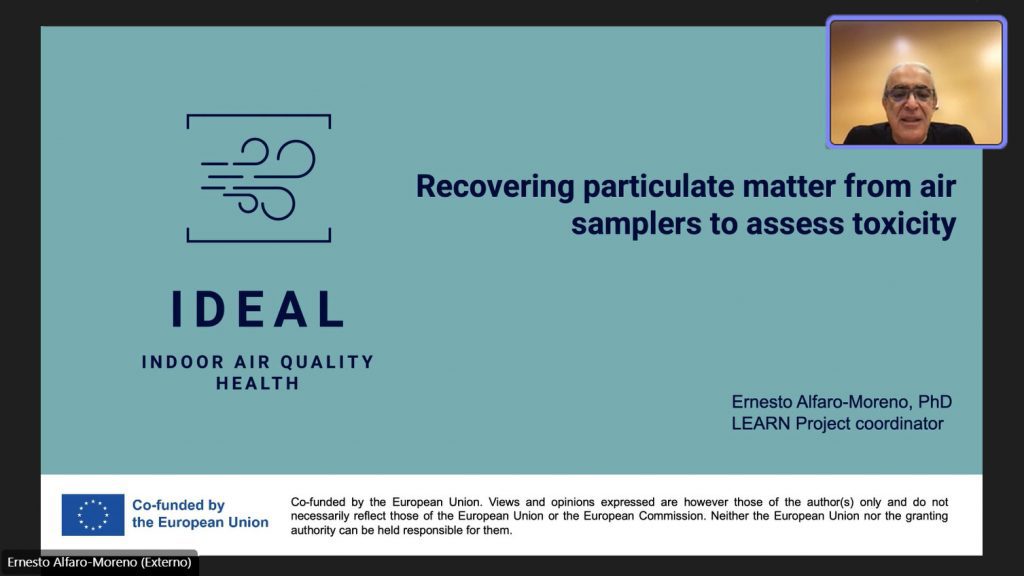
IDEAL cluster setup for formaldehyde exposure analysis for in vitro models
To follow, José Fermoso Domínguez, the K-HEALTHinAIR project coordinator from CARTIF, presented the ‘IDEAL setup for formaldehyde exposure analysis for in vitro models’. He shared insights on the IDEAL cluster’s setup designed for analysing formaldehyde exposure on in vitro models, offering a framework that could improve accuracy and relevance in toxicological testing.
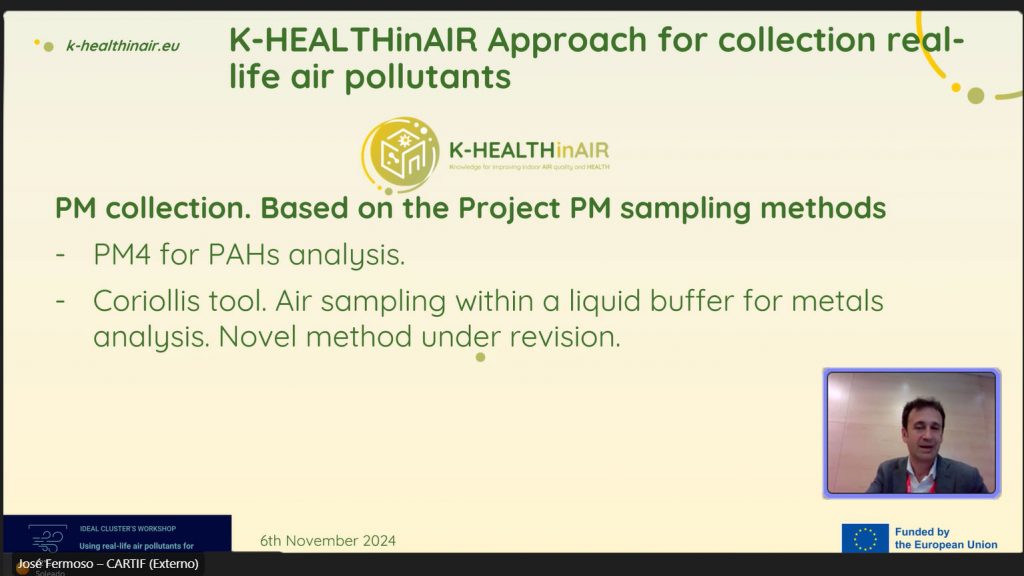
Overall, both of them shared the approach of their projects on air pollution and toxicology and highlighted the importance of collaborative efforts in advancing research in this field.
The IDEAL cluster’s working group on in vitro models
The workshop was held online within the framework of the IDEAL cluster’s Working Group 7 on ‘In vitro models’, also led by INL in representation of the LEARN project. This working group focuses on exploring the interplay between indoor air quality and human health by utilising in vitro and in vivo models, which can help understand and thus mitigate the harmful effects of indoor air pollutants.
The LEARN project is a Horizon Europe project meant to monitor and evaluate indoor air quality at schools around Europe and its impact on children’s health. Our main goal is to develop and deploy novel sensors that can detect possibly harmful air pollutants, as well as advanced biosensors and optimised air remediation strategies. Find out more about our EU-funded project!