Researchers from the International Iberian Nanotechnology Laboratory (INL), the LEARN project’s coordinator, have published a new paper in the Optics Express journal, exploring selective VOC detection by using VUV light generated through THG from dielectric nanomembranes.
The article, entitled ‘Volatile organic compound photoionization utilizing tunable quasi-monochromatic vacuum ultraviolet down to 120 nm obtained by third harmonic generation from a suspended dielectric nanomembrane‘, was developed in the Diéguez group under the scientific leadership of Pieter De Beule.
This research means a step forward for the LEARN project’s Work Package 4, specifically for the development of novel sensors to detect Volatile Organic Compounds (VOCs) in the air. The demonstrated ability to generate tunable VUV light and detect VOCs in real-time using a compact, scalable system supports the goals of creating sensitive, integrable, and field-deployable sensors.
Detecting VOCs through VUV light generated by THG from a suspended dielectric nanomembrane
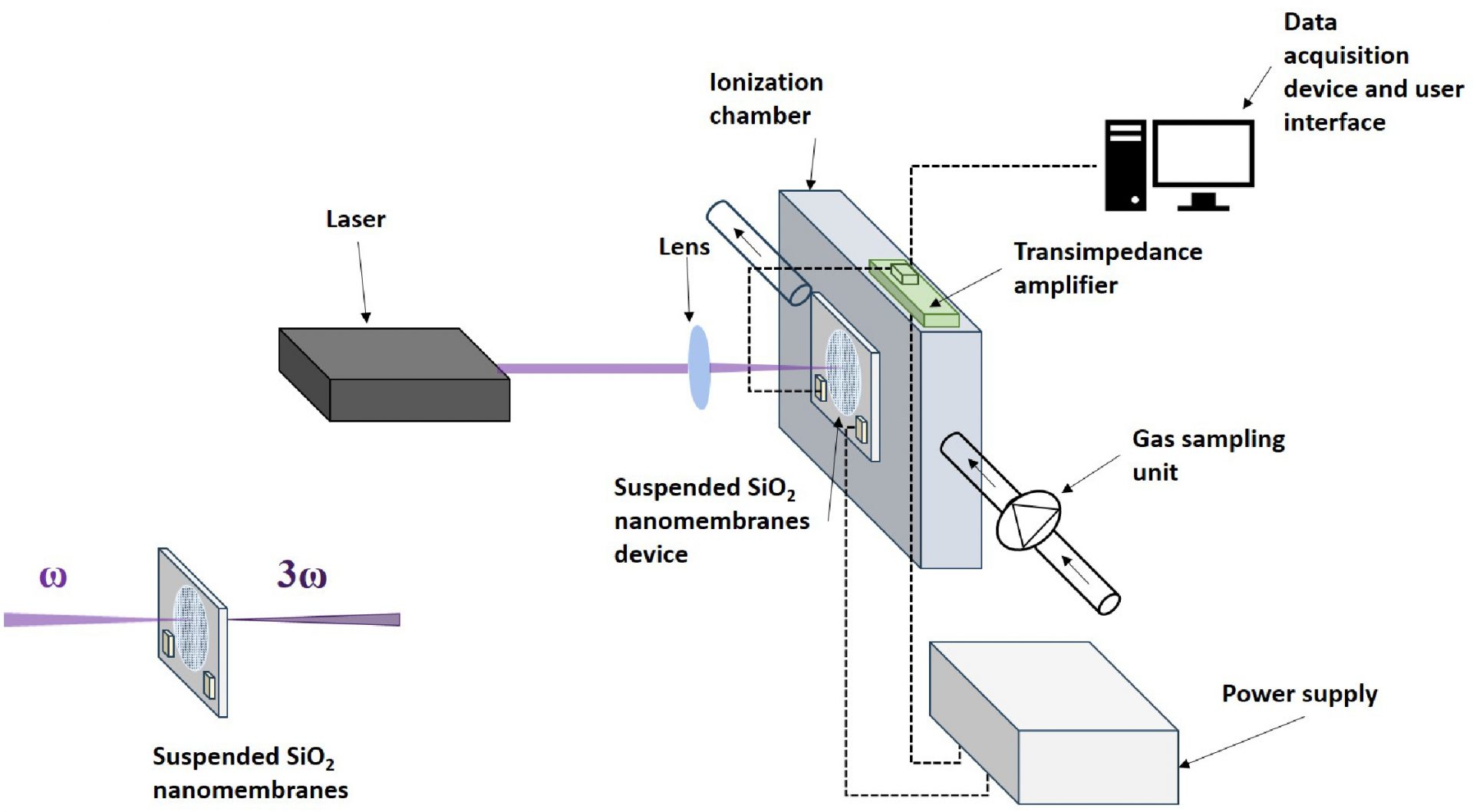
The article presents a novel tabletop system for detecting volatile organic compounds (VOCs) using tunable vacuum ultraviolet (VUV) light generated via third harmonic generation (THG) from suspended SiO₂ nanomembranes.
The system integrates a femtosecond laser, optical parametric amplifier, and custom-built photoionisation detector to achieve VUV wavelengths down to 120 nm. This setup enables selective photoionisation of VOCs such as ethanolamine and eucalyptol at ambient conditions, demonstrating a significant advancement over traditional VUV sources that are typically bulky, monochromatic, and require vacuum environments.
The research highlights the optimisation of THG efficiency through both analytical and FDTD simulations, confirming the sinusoidal dependence of THG intensity on nanomembrane thickness and coherence length. The fabricated device includes multiple nanomembranes and integrated electrodes for current detection, allowing real-time monitoring of VOC-induced photoionisation currents.
Source: Vilarinho, R., Mahmoodnia, H., Maibohm, C., Poeta, D., Fernandes, J., Calaza, C., Gómez-Varela, A. I., López-Garcia, M., Miranda, A., & De Beule, P. A. A. (2025). Volatile organic compound photoionization utilizing tunable quasi-monochromatic vacuum ultraviolet down to 120 nm obtained by third harmonic generation from a suspended dielectric nanomembrane. Optics Express, 33(12), 26342–26355. https://doi.org/10.1364/OE.564577
The LEARN project is a Horizon Europe project meant to monitor and evaluate indoor air quality at schools around Europe and its impact on children’s health. Our main goal is to develop and deploy novel sensors that can detect possibly harmful air pollutants, as well as advanced biosensors and optimised air remediation strategies. Find out more about our EU-funded project!