The LEARN project has obtained a €7,550,974 Horizon Europe grant from the European Commission to research indoor air quality at schools in Europe and its impact on children’s health and cognition.
To that end, this EU-funded project will develop novel sensors, advanced biosensors and optimised remediation strategies, with the aim of improving children’s health in the long term.
The LEARN project’s consortium
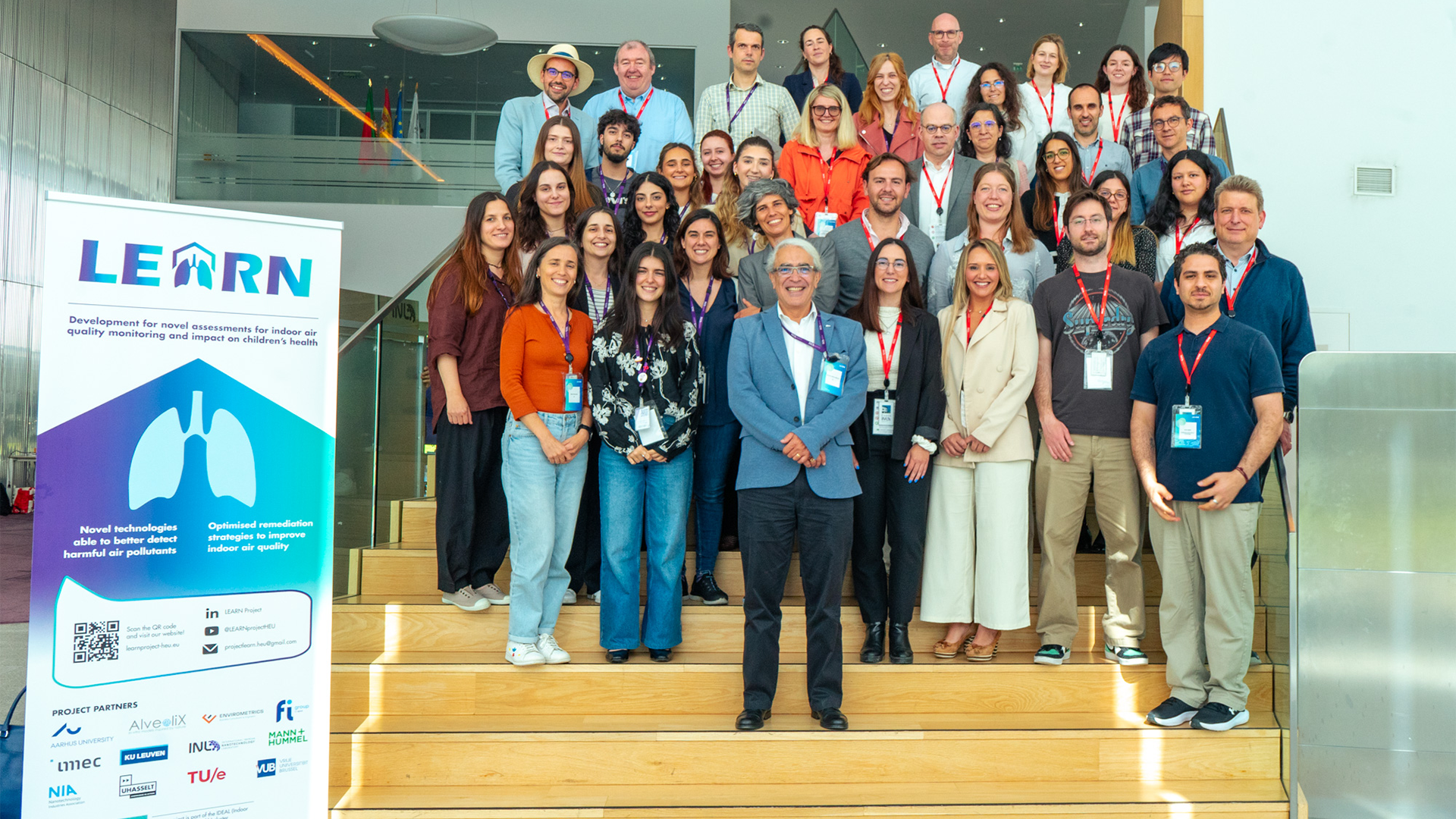
This Horizon Europe project is made possible thanks to a group of eleven partners1, coming from 8 different countries:
- Laboratorio Iberico Internacional de Nanotecnologia LIN-INL (Portugal) [coordinator]
- AARHUS UNIVERSITET (Denmark)
- ALVEOLIX AG (Switzerland)
- ENVIROMETRICS TECHNIKOI SYMVOULOI ETAIREIA PERIORISMENIS EFTHYNIS (Greece)
- FI Group (Spain)
- STICHTING IMEC NEDERLAND (Netherlands)
- KATHOLIEKE UNIVERSITEIT LEUVEN (Belgium)
- MANN + HUMMEL GMBH (Germany)
- NANOTECHNOLOGY INDUSTRIES ASSOCIATION (Belgium)
- UNIVERSITEIT HASSELT (Belgium)
- VRIJE UNIVERSITEIT BRUSSEL (Belgium)

Three pilots to monitor indoor air quality at schools in Europe
This EU-funded project will measure the presence of air pollutants in enclosed spaces. The main focus will be on detecting the presence of nanoparticles, such as volatile organic compounds (VOCs) and ultrafine particles (UFPs), and the potential long-term cognitive problems affecting children’s health that may be associated with them.
To this end, partners will take blood and urine samples from school children to measure the exposition level of air pollutants in indoor environments, using advanced microscopy techniques that allow us to identify the number of particles found in blood and urine.
To create a consistent database, this EU-funded project will base its three cohorts on three different levels of social development in Europe: Denmark, Belgium, and Greece.
Advanced biosensors to analyse the effects of air pollutants
Another important component, which we will do in Portugal and Switzerland, is to analyse the effects of pollutants on human cells. For this purpose, we will use advanced equipment called organ-on-a-chip which will enable us to see what kind of responses are generated at the molecular level, cell by cell. The goal is to recognise early indicators of damage to a child’s lung from air pollutants.
An essential aspect of the project is to improve young people’s health through technology and the results achieved in the 4-year period. Ernesto Alfaro-Moreno, the LEARN Project’s coordinator, mentions that it’s not just about detecting pollution in the air and putting in filters; the project will also measure how it affects children´s lung health and cognitive development.
The investment of almost 8 million euros in research funding to analyse indoor air quality, detect the presence of particulate pollutants at the nanometre scale and identify possible impacts on children’s health through sensors and biosensors, will be more than covered by the progress made during the four years the project is set to take place.
The project has the potential to make a big difference in the long-term lung health of young people, in the words of Cristina Nappi, Senior Consultant of EU-funded projects from FI Group.
The key elements of the LEARN project
In summary, this Horizon Europe proposal includes:
- The evaluation of indoor air quality at schools and levels of exposure of children in three different countries (Denmark, Belgium, and Greece). Indoor air quality will be evaluated by measuring a wide range of chemicals, microbiological composition, and particulate matter.
- The development of novel sensors that will serve to quantify concentrations of volatile organic compounds (VOCs) and ultrafine particles (UFPs).
- The evaluation of the potential toxicity of selected indoor air pollutants.
- Preparation of a strategy for air remediation using advanced and high-performance filtration systems and air purifiers.
The LEARN Project is funded by the European Commission under the Horizon Europe Grant Agreement 101057510. It is also part of the IDEAL cluster, a European initiative which gathers seven Horizon Europe projects dealing with indoor air quality and health.
To get involved in our activities, please visit our website learnproject-heu.eu and follow the hashtag #LEARNproject on social media.
- A new partner joined the consortium in May 2023: Eindhoven University of Technology (TU/e), from The Netherlands. For more information, please check the consortium section on the homepage. ↩︎