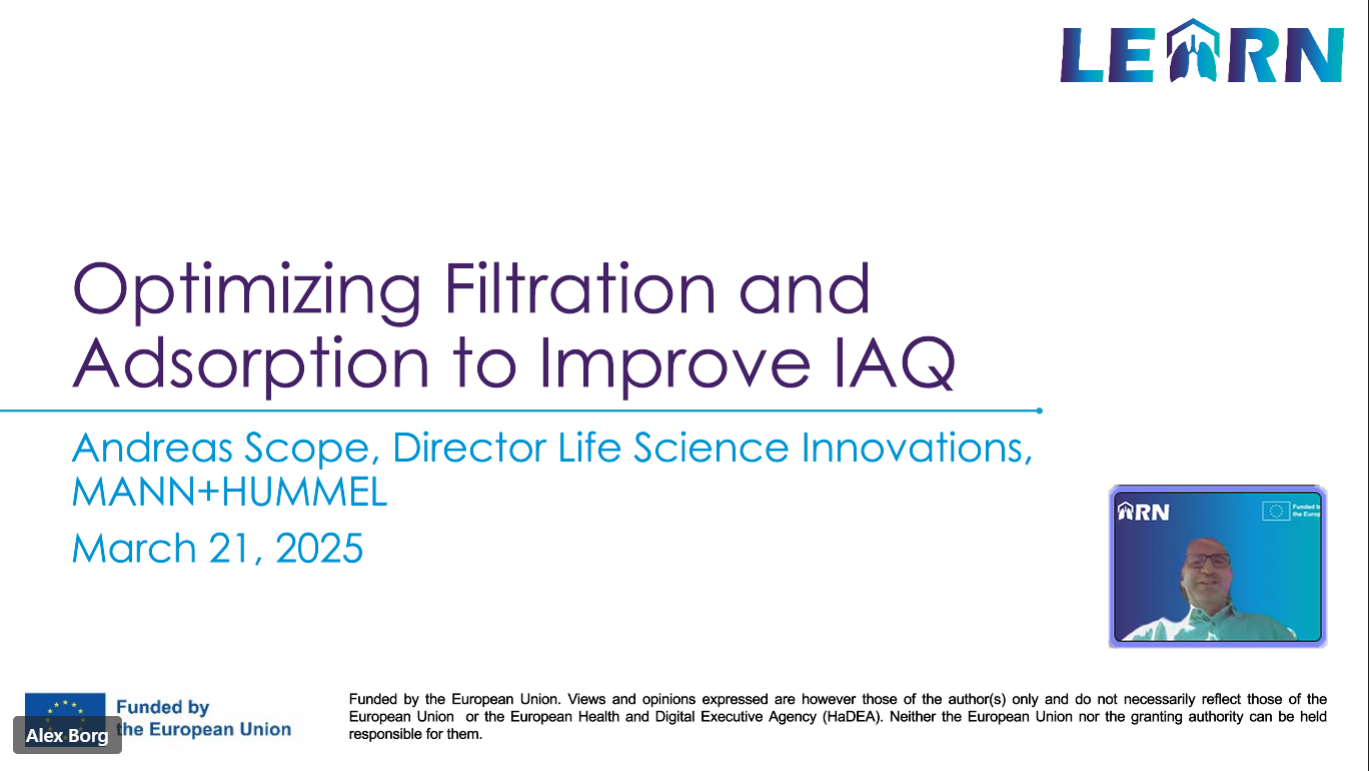
On March 21st 2024, Andreas Scope from our partner MANN+HUMMEL participated as a speaker and panellist in the webinar “Don’t hold your breath: Implementing effective ventilation strategies for healthy indoor spaces“.
The session was co-organised by the EDIAQI project and the LEARN project, both part of the European IDEAL cluster on indoor air quality and health, and also counted on the participation of the Air Infiltration and Ventilation Centre (AIVC).

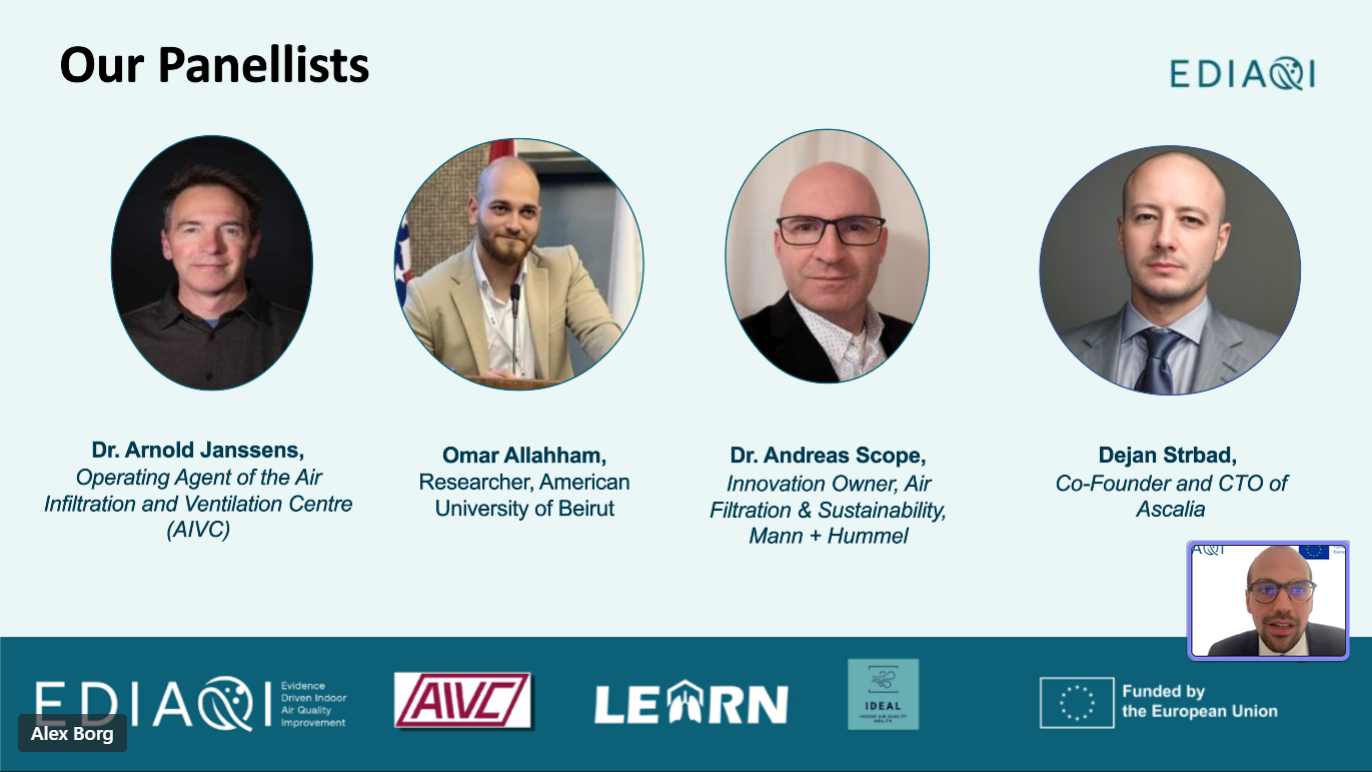
After an introduction of the need for advanced ventilation and filtration technologies to improve indoor air quality by Alex Borg, communication manager of EDIAQI, different presentations followed from the four experts invited:
- Arnold Janssens from AIVC, who explained how smart ventilation systems are reshaping building design and operation by balancing energy performance with pollutant control.
- Omar Allahham, who presented a powerful case study on ventilation in complex infrastructure settings such as Beirut’s Salim Salam Tunnel.
- Andreas Scope from MANN+HUMMEL, who explained how filtration and adsorption technologies are being adapted to the school environment in the LEARN project cohorts, in order to protect the health of vulnerable groups such as children.
- Dejan Strbad from Ascalia, who provided a live demo of the EDIAQI filtration pilot, revealing the technology behind the project’s AI-enhanced ventilation system.
Adapted filtration technologies for the LEARN project cohorts at schools
During his presentation, Andreas Scope, from our partner MANN+HUMMEL, gave valuable insights on optimising air filtration for vulnerable groups.
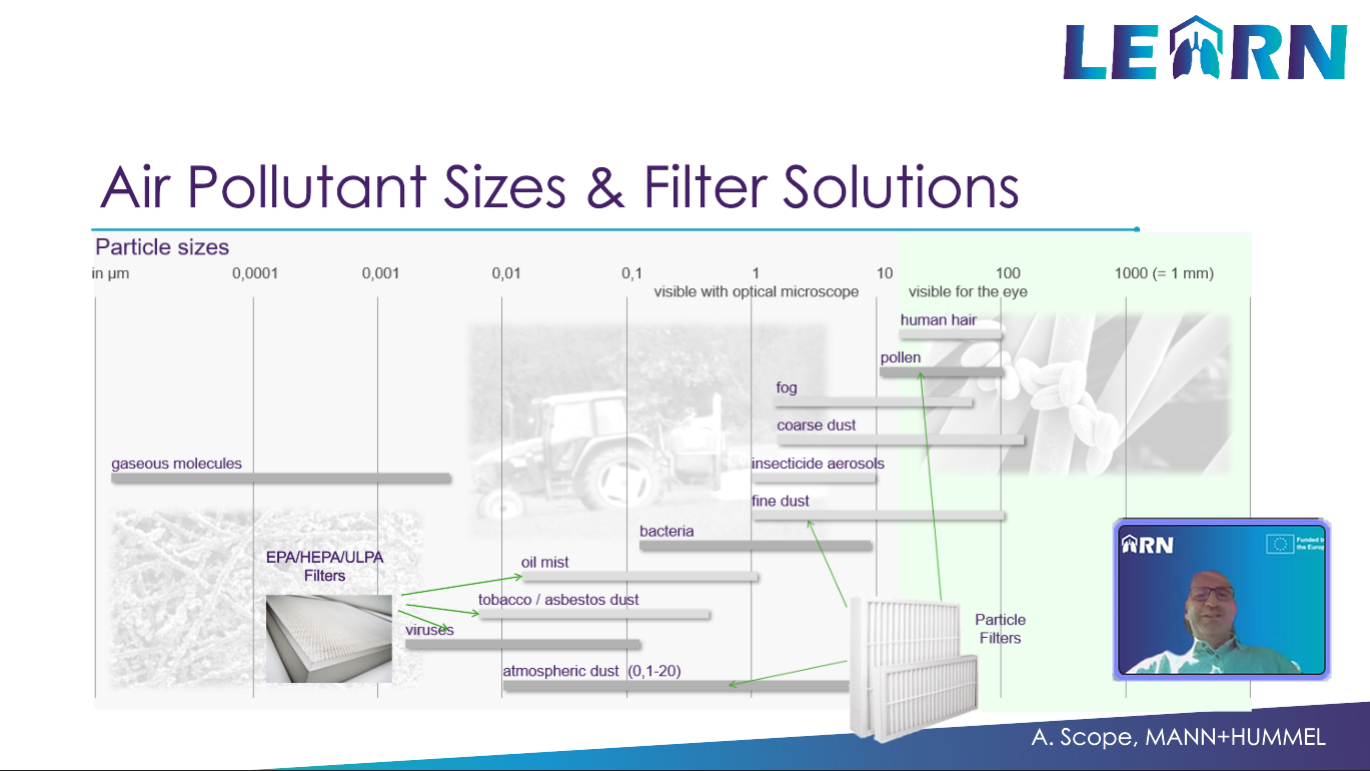
He first raised awareness of the risks of airborne contaminators, with the smallest particles being the most dangerous because of their ability to get into the respiratory system. He then presented the different filtration solutions available for each air pollutant particle size.
Then, Andreas explained the difference between air filtration and absorption, and how it is possible to combine them and create the best solution for each situation by using different materials and technologies.
To end with, he presented how this is being done in the LEARN project, where MANN+HUMMEL is optimising their filtration and adsorption technologies for the school environments, finding a balance between best performance, energy efficiency, and cost affordability for the schools and parents. Even though this might be a challenge, he reinforced how even affordable filters can make a difference in health. Moreover, smart air purifiers can act depending on the data received from the VOC and UFP sensors, directly tackling the particles found in the air and thus increasing energy efficiency.
Watch the full webinar here!
The LEARN project is a Horizon Europe project meant to monitor and evaluate indoor air quality at schools around Europe and its impact on children’s health. Our main goal is to develop and deploy novel sensors that can detect possibly harmful air pollutants, as well as advanced biosensors and optimised air remediation strategies. Find out more about our EU-funded project!