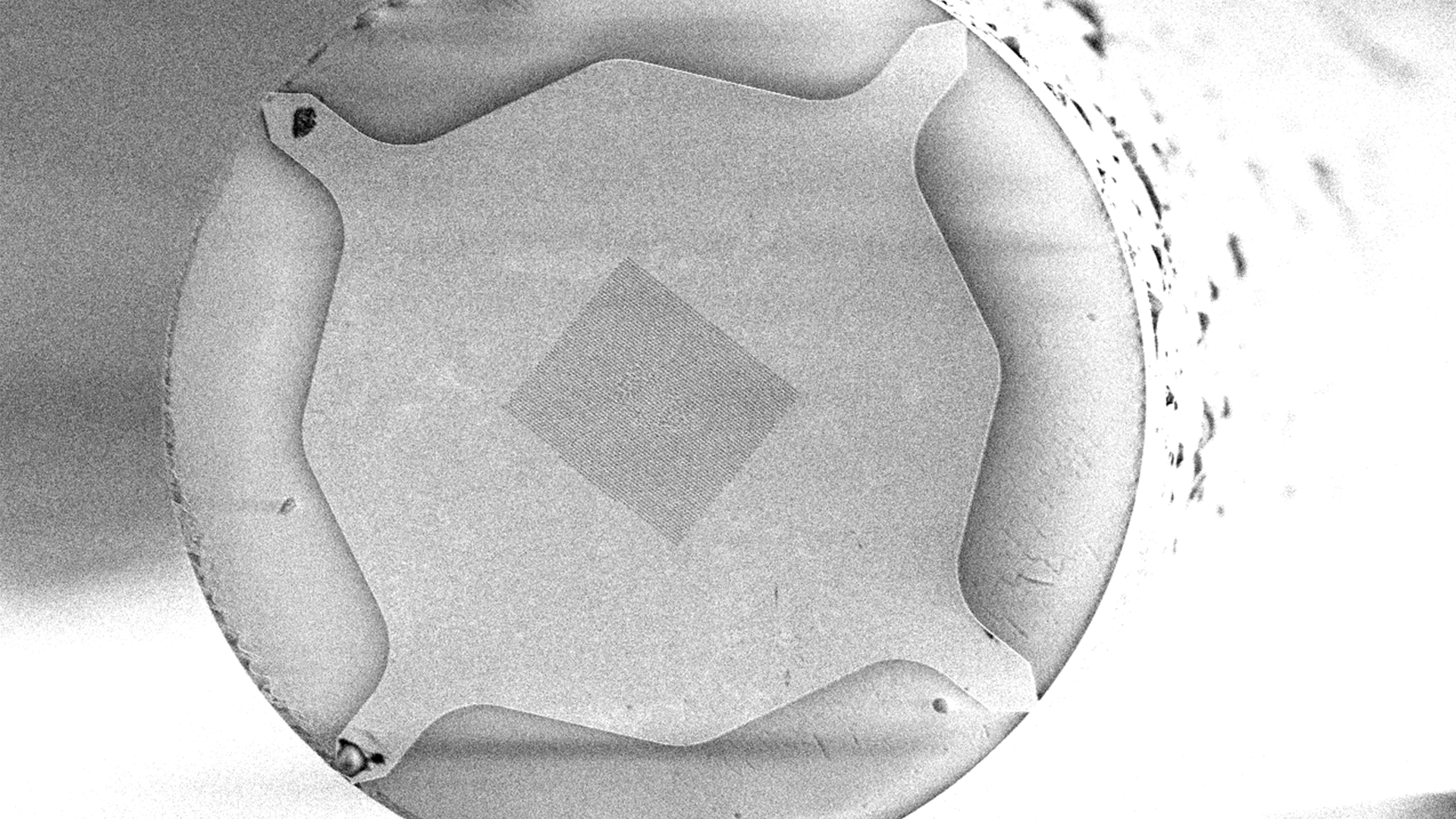
Understanding and improving air quality in schools is a central goal of the LEARN project. A particular focus is on ultrafine particles (UFPs) — particles smaller than ~100 nm — that are able to penetrate deep into the respiratory tract, cross biological barriers, and reach sensitive organs.
Despite growing evidence that UFP exposure may contribute to adverse health outcomes, their concentrations in everyday indoor environments such as classrooms remain poorly characterised. Affordable, compact sensors that can continuously monitor UFPs in real time would enable large-scale measurements in schools, homes, and workplaces, and would help epidemiological studies link exposure to health.
Within the LEARN project, Work Package 4 advances the research, design, and prototyping of such UFP sensors for continuous and cost‑effective indoor air‑quality monitoring, with one main thrust dedicated to UFP detection.
Why are new UFP sensors needed?
Today’s widely available particle sensors were designed around micrometre-scale aerosols (PM10 and PM0.5) and cannot detect aerosol particles in the sub‑100 nm regime. For standard optical particle counters, the light‑scattering signal falls steeply as particle size decreases, which pushes practical detection limits to the few‑hundred‑nanometer range.
To access the true UFP regime, specialised instruments are required, which rely on electrical mobility classification and condensation growth before optical readout. While powerful, these instruments are bulky, expensive, and maintenance‑intensive; some require hazardous working fluids (e.g., n‑butanol) for condensation growth, and thus are ill‑suited for distributed monitoring in indoor environments such as schools.
Alternatives based on direct charge detection (e.g., Faraday‑cup schemes) avoid condensational growth but typically need kilovolt ionisation and sub‑nanoampere current measurements, which limit sensitivity and keep costs high. In short, none of the established approaches simultaneously offer the needed sensitivity, size, cost, and simplicity for wide deployment. This motivates a new detection principle targeted specifically at UFPs.
A new detection principle for UFPs sensors
To address these challenges, we are developing a miniaturised nanophotonic sensor on a fibre tip capable of single‑particle detection without condensation growth1. The device integrates a photonic‑crystal (PhC) cavity onto the end face of a standard optical fibre.
The nanophotonic structure tightly confines light in a sub-micrometre detection region near the fibre tip, which makes the reflected signal exquisitely sensitive to local refractive‑index changes. When a nanoparticle enters this detection region, its presence perturbs the optical resonance and can be read out as a change in the reflected optical signal. We have recently shown that this allows us to detect single UFPs entering the detection region.
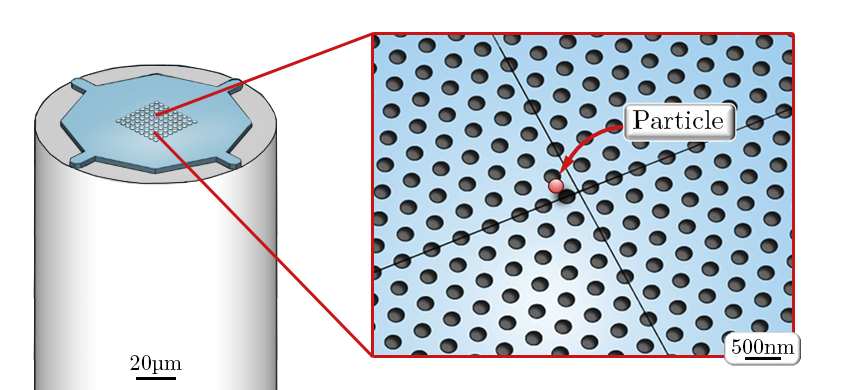
Optical UFP sensor: fabrication and working principle
Fabrication begins with patterning multiple devices on an InP wafer using standard cleanroom processes. Each device includes a quasi‑periodic array of holes in a ~200 nm‑thick membrane that forms a PhC cavity. Devices are transferred wafer‑to‑fibre by picking up the membrane onto a bare fibre tip; the membrane adheres via van‑der‑Waals forces, with no adhesive layer, enabling reliable, scalable assembly2. The hole pattern is engineered to couple light efficiently between the fibre and the cavity1.
In operation, a laser is launched through the fibre at (or near) the cavity resonance; changes in the local environment at the tip — e.g., when nanoparticles enter the detection volume — shift the resonance and therefore the reflected power, which provides the sensing signal.
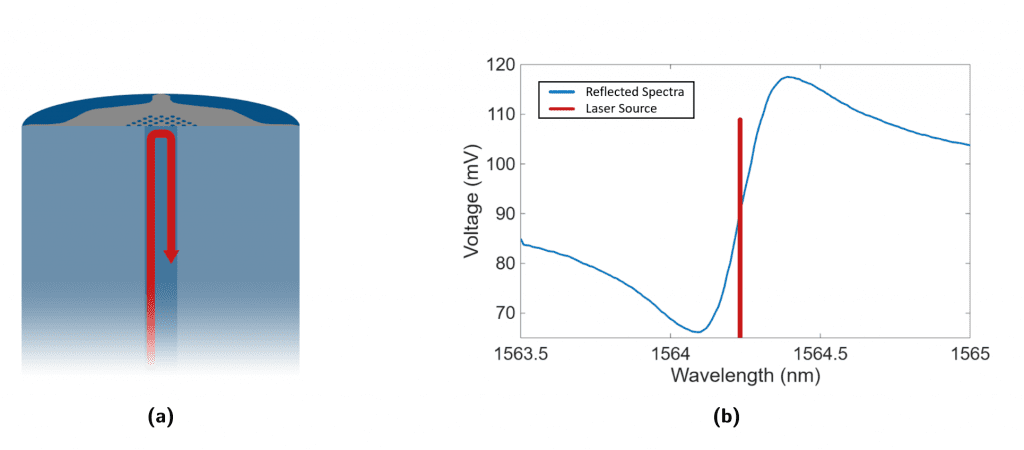
Optical UFP sensor: proof‑of‑principle detection in liquid
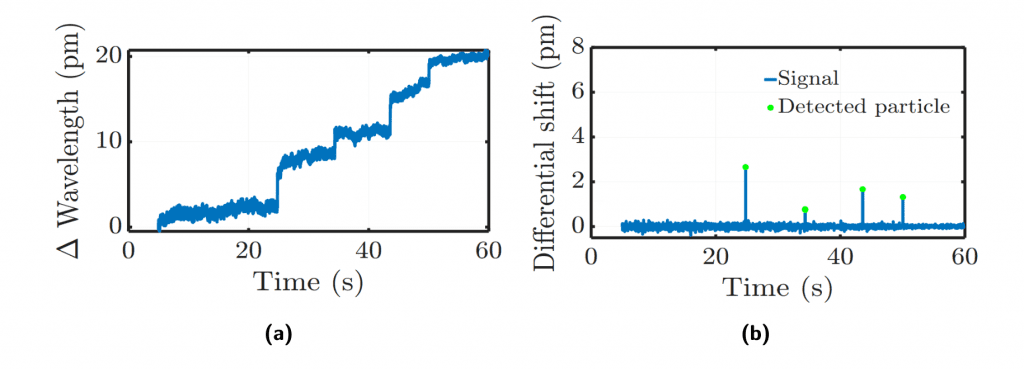
To validate the sensing concept under controlled conditions, we conducted proof‑of‑principle experiments in liquid. The fibre tip is connected to a flow cell that delivers nanoparticles across the detection region. When particles bind to, or pass through, the detection region, the resonance shifts due to the local refractive‑index change. We have shown that by monitoring the reflected signal over time, we can resolve discrete steps corresponding to single‑particle events for particles down to ~50 nm in diameter1.
In‑air versus in‑liquid delivery methods
Delivering UFPs into such a small detection region is a central challenge, especially when the ultimate goal is measurement directly in air. A reliable system must remove particles larger than 100 nm (e.g., via inertial pre‑filtration) while efficiently concentrating and guiding the remaining UFPs into the small detection region.
We therefore investigate two complementary delivery strategies: in-liquid delivery and in-air delivery. The overall goal of both approaches remains to effectively deliver UFPs to the detection region, without relying on bulky conditioning stages or hazardous fluids.
In-liquid delivery
Because the sensor is already validated in liquid, we investigate in-liquid delivery. Here, we first capture UFPs from the air into a liquid and then deliver that liquid to the detection volume at the fibre tip. Capture mechanisms may exploit inertial impaction or electrostatic forces; transport to the detection region can then leverage microfluidic techniques, such as electrowetting‑driven droplet motion on a surface or pressure‑driven flow through microchannels.
This pathway offers stable optics and controlled flow, ideal for readout and calibration, at the cost of added sampling complexity and the need to periodically refresh the liquid near the sensor.
In-air delivery
Alternatively, UFPs can be delivered directly in air to the fibre tip. Guided by modelling and initial experiments, our current detection scheme is most effective when particles stick to the surface in the detection region, creating a measurable, lasting signal.
Delivery can be aided by inertial impaction or by electrostatic attraction towards the sensing region, with sticking dominated by van‑der‑Waals (and possibly electrostatic) forces. Key engineering goals are to:
- Focus and concentrate UFPs into the detection region
- Minimise transmission losses
- Develop gentle cleaning methods to periodically clear the surface once it becomes saturated with particles
Numerical modelling informs design choices (e.g., flow fields and particle trajectories) while experiments validate feasibility.
Next steps for the new UFP sensors in the LEARN project
Our current efforts centre on integrating the optical readout with delivery approaches that are practical for deployment:
- Electrostatic classification and concentration at low voltage to enrich the sub‑100 nm fraction upstream of the sensor3.
- Air‑to‑liquid sampling using microfluidic impingers and related methods to collect UFPs into a compatible liquid for reliable, calibrated readout4.
- In‑liquid manipulation strategies (e.g., electrophoretic or electro‑osmotic control in non‑polar media) to position and retain particles within the optical hotspot during measurement5.
In parallel, we are exploring larger effective detection regions — for example, by using photonic‑crystal surfaces without high‑Q cavities — which would allow LED‑based broadband illumination instead of a tunable laser, lowering cost at the expense of some sensitivity. The goal is a compact prototype suitable for classroom trials within the LEARN project: autonomous operation, low power, and wireless data.
By enabling distributed UFP measurements in real environments, this work will help build the datasets needed to understand children’s exposure and to inform strategies for cleaner, healthier indoor air.
Authors: Hasan Yalcinoglu, Mostafa Taghipour, Hans Wyss, Andrea Fiore.
References:
- A. L. D. R. M. D. e. a. Hendriks, “Detecting Single Nanoparticles Using Fiber‑Tip Nanophotonics,” Optica, vol. 11, no. 4, p. 512–18, 2024. ↩︎
- L. A. v. K. G. L. e. a. Picelli, “Scalable Wafer‑to‑Fiber Transfer Method for Lab‑on‑Fiber Sensing,” Applied Physics Letters, vol. 117, no. 15, 2020. ↩︎
- M. Chen, H. Wang, Q. Sun and e. al., “Simulation of Miniature PDMA for Ultrafine‑Particle Measurement,” Atmosphere, vol. 10, no. 3, p. 116, 2019. ↩︎
- I. M. S. M. C. a. H. S. Mirzaee, “A Microfluidics Based on Chip Impinger for Airborne Particle Collection,” Lab on a Chip, vol. 16, no. 12, p. 2254–64, 2016. ↩︎
- W. M. K. A. L. Z. e. a. Liu, “Enhanced Particle Transport in Nonpolar Solvents Driven by Electric Fields: Elucidating the Roles of Electrophoresis and Electro Osmosis Through Numerical Simulation,” Physical Review E , vol. 111, no. 1, 2025. ↩︎