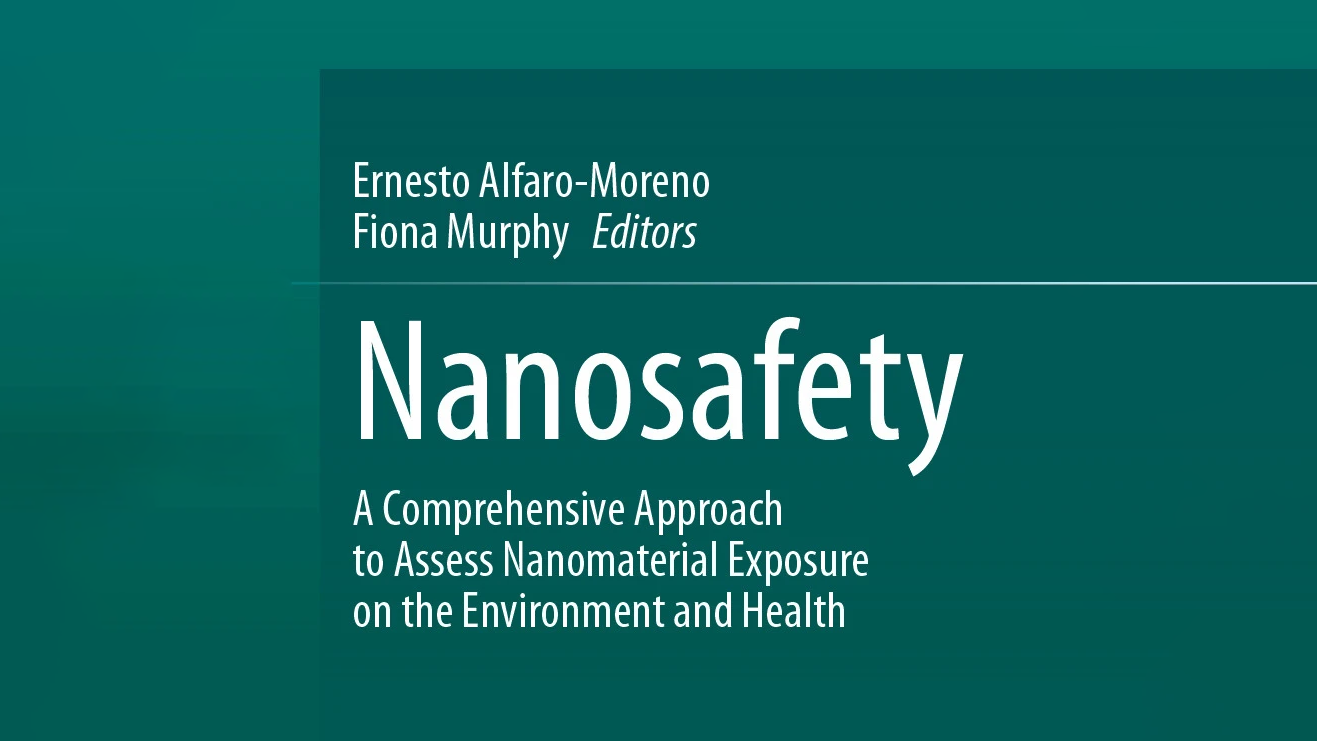
Researchers from the International Iberian Nanotechnology Laboratory (INL), the LEARN project’s coordinator, have published a new open-access book titled ‘Nanosafety: A Comprehensive Approach to Assess Nanomaterial Exposure on the Environment and Health‘.
The book, edited by Ernesto Alfaro-Moreno and Fiona Murphy and published under Springer Nature, provides insights and guidance for researchers, policymakers, and industries in the field of nanotechnology to ensure a responsible and safe development of nanomaterials and their applications.
Nanosafety is an important concern for the LEARN project. As part of its Work Package 5, INL is developing different models, such as advanced skin-on-chip models and models based on C.elegans, to assess the safety of nanomaterials. These models are being used to study the health and cognitive impacts of children exposed to air pollutants from nanoparticles in schools.
For that reason, the LEARN project is acknowledged in the following chapters of the book:
- ‘Nanosafety: Why Do We Need It?’ (pp 1–24)
- ‘Methodological Considerations for Setting Up Human-Relevant In Vitro Nanotoxicology Experiment: A Practical Guide’ (pp 27-53)
- ‘Advanced Skin Models for Nanomaterials Safety Assessment’ (pp 161–191)
- ‘Caenorhabditis elegans: A Bridging Model to Assess the Safety of Nanomaterials’ (pp 275–312)
- ‘Molecular Docking in Nanotoxicology’ (pp 481–509)
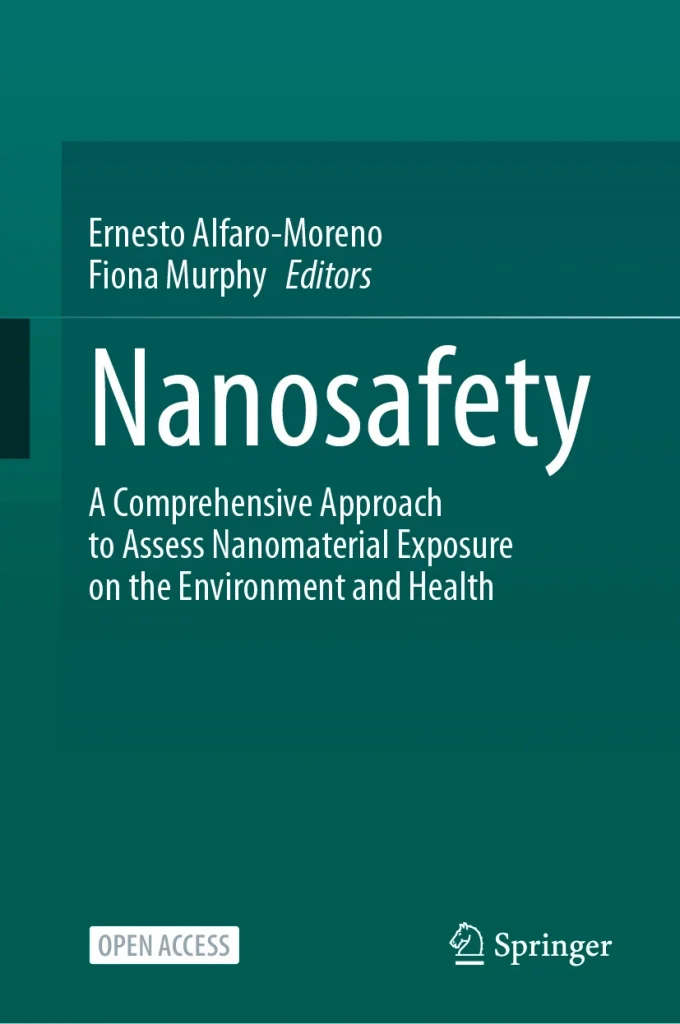
Nanosafety
A Comprehensive Approach to Assess Nanomaterial Exposure on the Environment and Health
Book | Open Access | © 2025
Nanosafety: Why do we need it?
Nanomaterials, characterised by their nanoscale dimensions, possess unique properties that enable diverse applications across various industries, including electronics, medicine, and consumer goods. However, these properties also raise significant health and environmental concerns.
Nanosafety encompasses the investigation and management of risks linked to the lifecycle of nanomaterials, from production to disposal:
- As they interact with biological systems, they can present altered toxicological profiles, prompting concerns over their cytotoxicity, immunotoxicity, and genotoxicity.
- Their environmental behaviour, such as their transport and potential for bioaccumulation, has an ecological impact that needs to be assessed.
How to conduct in vitro nanotoxicology experiments
The chapter ‘Methodological Considerations for Setting Up Human-Relevant In Vitro Nanotoxicology Experiment: A Practical Guide‘ (pp 27-53) covers the comprehensive characterisation of the nanomaterials, the selection of appropriate in vitro models to ensure relevance to human exposure scenarios, the choice of test methods and controls to account for potential nanoparticle interference with the selected assays, accurate practices for nanomaterial sample preparation and the importance of dosimetry, and awarenees of exposure concentrations to ensure that testing remains biologically and environmentally relevant.
Advanced skin-on-a-chip models for nanosafety assessment
The chapter ‘Advanced Skin Models for Nanomaterials Safety Assessment‘ (pp 161–191) reviews the main pollutants that the skin is exposed to and proposes to employ advanced skin-on-a-chip devices for the safety assessment of nanomaterials on the skin. Thanks to the use of microfluid technologies, these devices offer dynamic environments for more realistic evaluations, which can accelerate nanotoxicity testing and support regulatory decisions.
Models based on C.elegans for nanosafety assessment
The chapter ‘Caenorhabditis elegans: A Bridging Model to Assess the Safety of Nanomaterials‘ (pp 275–312) focuses on the role of C.elegans as a bridging model in nanotoxicology and nanosafety research. With its simple multicellular structure, well-characterised genetics, low maintenance costs, short life cycle, and suitability for high-throughput screening, C. elegans is effective for evaluating nanoparticle toxicity across various exposure scenarios, including acute and chronic treatments.
Molecular docking in nanotoxicology
The chapter ‘Molecular Docking in Nanotoxicology‘ (pp 481–509) outlines the characteristics and applications of molecular docking simulation, such as nano-biointeractions and potential side-effect/nanotoxicity relationship prediction. It explores key nanoparticle interactions at the molecular level, particularly regarding DNA interaction, towards a rational nanomaterial design with the desired lowest nanotoxicity possible for safer biomedical applications.
Source: Alfaro-Moreno, E., & Murphy, F. (Eds.). (2025). Nanosafety: A comprehensive approach to assess nanomaterial exposure on the environment and health (1st ed.). Springer Cham. https://doi.org/10.1007/978-3-031-93871-9
The LEARN project is a Horizon Europe project meant to monitor and evaluate indoor air quality at schools around Europe and its impact on children’s health. Our main goal is to develop and deploy novel sensors that can detect possibly harmful air pollutants, as well as advanced biosensors and optimised air remediation strategies. Find out more about our EU-funded project!