Air pollution from volatile organic compounds (VOCs) is a major health and societal concern, with direct impacts on cognitive development in schoolchildren.
The INL team working at the LEARN project’s Work Package 4 (WP4) is addressing the limitations of current VOC sensing technologies by developing Sample Ionisation Potential Spectroscopy (SIPS), a novel method that enables real-time, selective detection of individual VOCs at atmospheric pressure. This breakthrough allows for accurate assessment of air toxicity, especially in indoor environments like schools, where VOC exposure can hinder learning capacity.
Moreover, by validating SIPS with both common household and hazardous Benzene, Toluene, Ethylbenzene, and Xylene (BTEX) compounds, and securing international patents, the team is moving towards market-ready solutions that support the EU’s Zero-Pollution Vision for 2050 and the United Nations 2030 Sustainable Development Agenda. These innovations promise significant benefits for public health, education, and environmental policy across Europe.
VOCs: a grand societal problem that affects schoolchildren’s learning capacity
Air pollution represents one of the greatest environmental threats to human health and has been identified as a leading cause of non-communicable diseases such as heart attacks or stroke. According to the World Health Organization (WHO), there are seven million premature deaths every year due to the combined effects of outdoor and household air pollution, with millions more people falling ill from breathing polluted air.
Toxicologists have widely investigated the adverse effects of air pollution on human health, reporting substantial societal and economic impacts. Volatile organic compounds (VOCs) and particulate matter (PM) are the prime constituents of air pollution.
VOCs are compounds that easily evaporate under normal indoor atmospheric conditions of temperature and pressure. VOCs exhibit a wide span of toxicity dependent on the molecular nature and associated concentration. VOCs are known to originate from anthropogenic or biogenic sources, with anthropogenic sources in an indoor environment originating from cleaning products, paints, new furniture, etc.
Many economic areas benefit from VOC identification and characterisation, as depicted here:
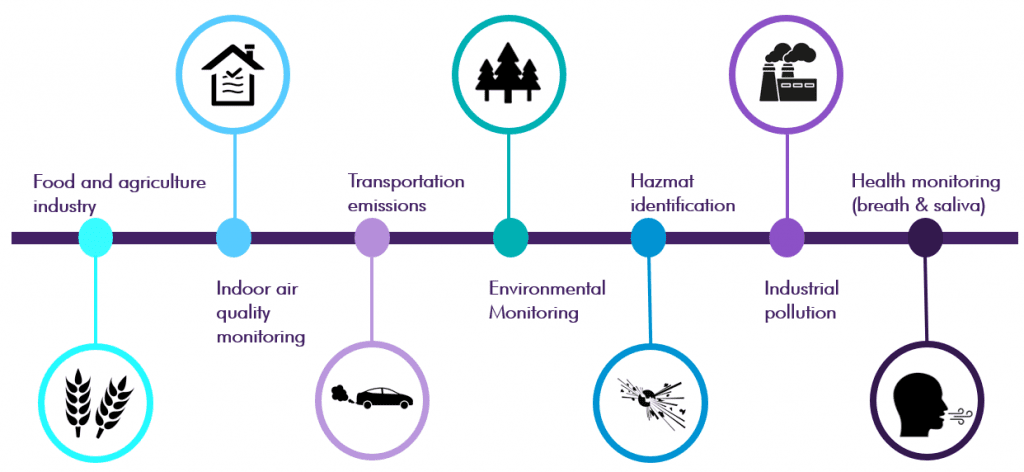
Certain VOCs have been proven to affect the cognitive learning ability of schoolchildren. Hereby, it was noted that schools located in urban or suburban environments closely related to busy road traffic, petrol stations, or factories performed worse in VOC pollution. Hence, it is perceived as an essential part of indoor air quality monitoring in schools to determine VOC concentrations.
The LEARN project: adding new capabilities to state-of-the-art VOC sensing, enabling real-time toxicity evaluation
Restrictions of state-of-the-art VOC sensing technology
Air toxicity depends on the molecular species making out the VOC mixture present in the ambient air and their respective concentration levels.
There exists no gas sensor technology that can determine the chemical compound breakdown of VOC pollutants in the air and their respective concentrations in real-time. Most commonly, gas sensors only determine the aggregate of VOCs present, making a toxicological determination of acute or chronic exposure as safe or hazardous impossible.
Sample Ionisation Potential Spectroscopy (SIPS), a novel approach for real-time selective VOC sensing
The ionisation potential of an atom or molecule in the gas form is the minimum energy required to eject an electron from the outermost shell. To every atom or compound/molecule, there is a unique ionisation potential associated.
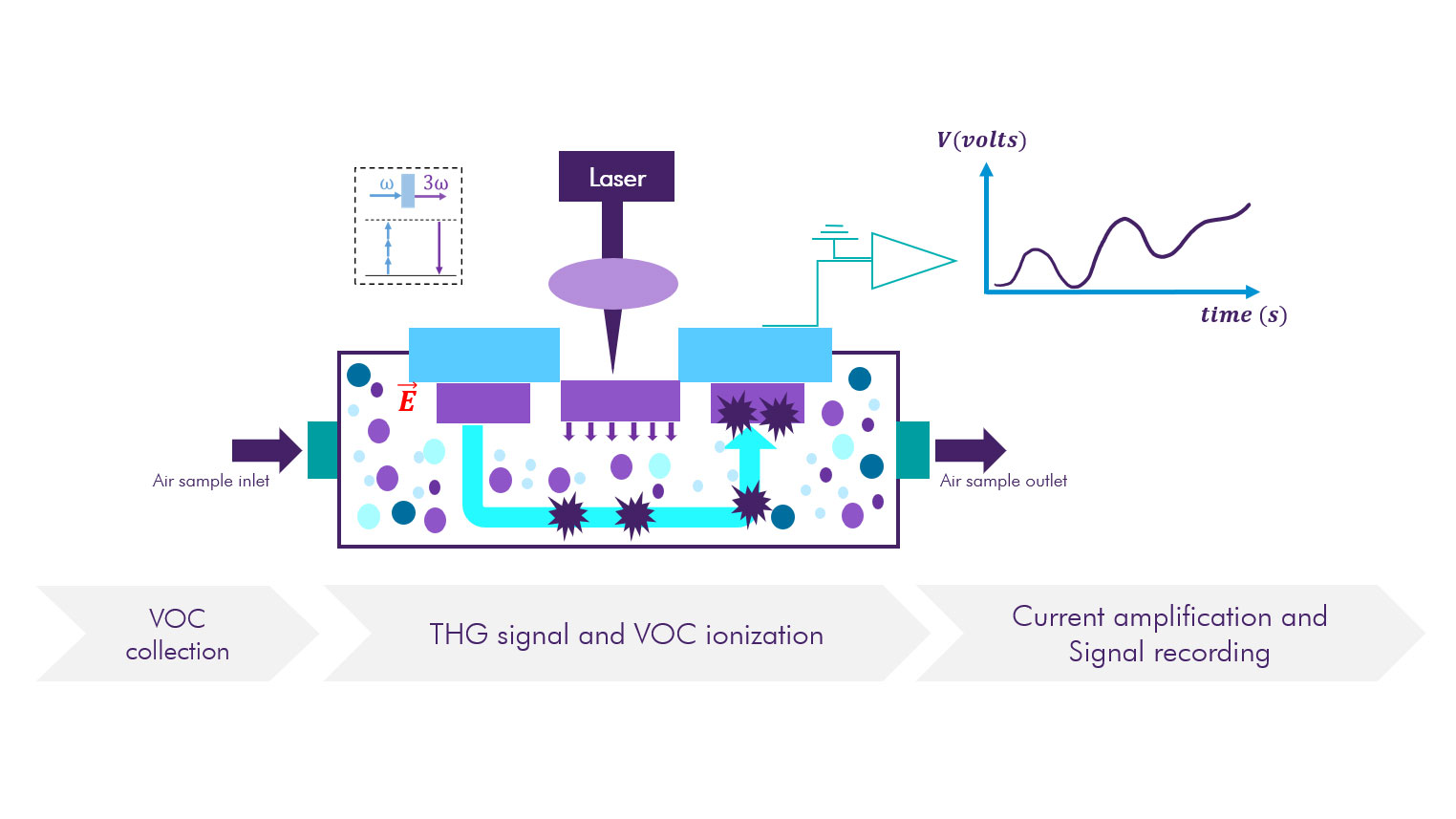
The INL WP4 team in the LEARN project has been developing a breakthrough technology based on ionisation potential determination that has demonstrated a molecular selective and real-time determination of VOC pollutants in an air sample, referred to as Sample Ionisation Potential Spectroscopy (SIPS).
This feat was achieved through a measurement at atmospheric pressure, avoiding the complexity of vacuum equipment and design. A first-generation prototype of SIPS was fully described in an article published in Optics Express.
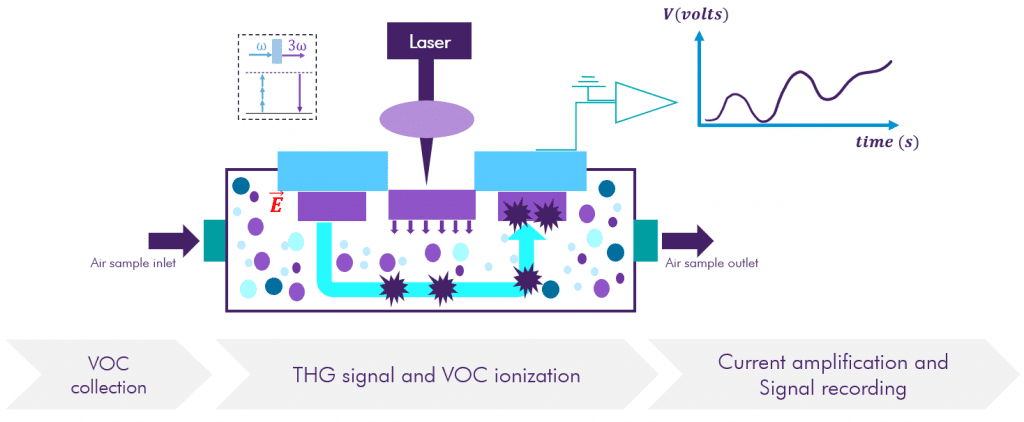
SIPS consists of generating monochromatic VUV light, whereby the central wavelength of the emission is tunable to the ionisation potential of a molecule. This is enabled by the combination of a laser setup with suspended dielectric nanomembranes via third-harmonic generation. Through the act of scanning the central wavelength, we can obtain a spectrum of ionisation currents that can be utilised to determine the selective concentration of individual VOCs based on their specific ionisation potential.
Approaching the end of 2025, the INL WP4 team in the LEARN project demonstrated the SIPS proof-of-principle concept in a laboratory environment, as outlined here:
An improved SIPS prototype to detect the complex mixture of VOCs
Initially, SIPS was validated with VOCs such as ethanolamine, eucalyptol and limonene, compounds that can be found in household common products such as all-purpose cleaners, cosmetics and lotions, shampoos and conditioners, toothpaste and air fresheners. Subsequently, this technology was validated in a mixture of VOCs that evaporated from a muscle ointment. Based on the ingredient list of this pharmaceutical product, the SIPS technology was able to selectively ionise each VOC component of the gas matrix sample.
A second-generation prototype of the SIPS technology with improved sensitivity and selectivity was built through the redesign of the photonic chip used for third harmonic generation. This was utilised to validate responsivity to a class of chemicals known as the BTEX group, consisting of benzene, toluene, ethylbenzene, ortho and para xylene isomers.
These compounds have been widely identified and characterised as air pollutants. While in the outdoors they derive primarily from fossil combustion, gasoline, vehicle exhaust, their presence indoors is attributed to, for example, furniture and construction materials. Benzene, toluene and xylene isomers are also known as ozone precursors, and their interaction has implications for climate effects and chemistry in the atmosphere.
From a toxicological perspective, they are associated with different health hazards: benzene is classified as a human carcinogen; toluene is linked to brain and nervous system effects; ethylbenzene is an animal carcinogen; and xylenes have been reported to cause respiratory irritation. Aside from links between BTEX and incidences of overall and site-specific cancers, BTEX is recognised as an inhibitor of cognitive development of school children.
Using the SIPS technology, the selective detection of individual BTEX compounds was demonstrated within a BTEX mixture, calibrated to the occupational exposure limits established by the European Union. This achievement is a significant step forward on the road towards real-time toxicological evaluation of air quality hampered by the presence of a complex mixture of VOCs.
The intellectual property associated with the SIPS innovation has been protected through a patent application with the Portuguese patent authority (August 2024), expanded to a PCT International Application (July 2025).
Bringing real-time selective VOCs sensing to the market
As of November 2025, the INL team is converting the laboratory setup into a transportable one to perform a field test at a local school in Braga, Portugal. Beyond the LEARN project, INL aims to bring to the market a user-friendly device for the selective detection of VOCs in real-time at atmospheric pressure.
Moreover, this cutting-edge SIPS technology contributes to the EU Zero-Pollution Vision for 2050. This cross-cutting objective contributes to the United Nations 2030 Agenda for Sustainable Development and is relevant to the European Green Deal and other initiatives of the European Commission.
Team members: Diogo Poeta, Hedieh Mahmoodnia, Adelaide Miranda, Pieter De Beule.
References: Vilarinho, R., Mahmoodnia, H., Maibohm, C., Poeta, D., Fernandes, J., Calaza, C., Gómez-Varela, A. I., López-Garcia, M., Miranda, A., & De Beule, P. A. A. (2025). Volatile organic compound photoionization utilizing tunable quasi-monochromatic vacuum ultraviolet down to 120 nm obtained by third harmonic generation from a suspended dielectric nanomembrane. Optics Express, 33(12), 26342–26355. https://doi.org/10.1364/OE.564577
The LEARN project is a Horizon Europe project meant to monitor and evaluate indoor air quality at schools around Europe and its impact on children’s health. Our main goal is to develop and deploy novel sensors that can detect possibly harmful air pollutants, as well as advanced biosensors and optimised air remediation strategies. Find out more about our EU-funded project!