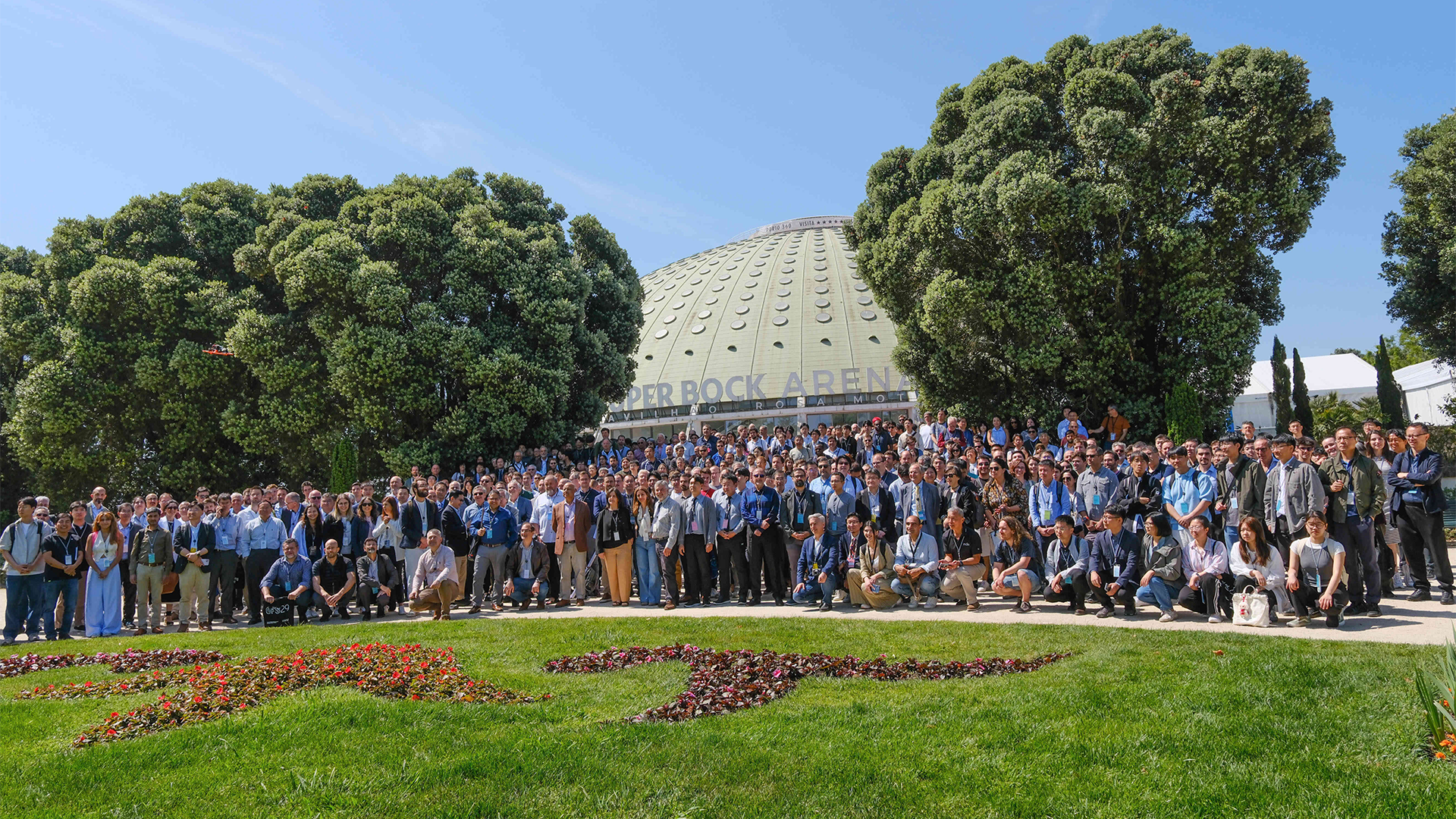
The 29th International Conference on Optical Fiber Sensors (OFS29) took place from the 25th to the 30th of May 2025 in Porto, Portugal. Organised by INESC TEC and SPIE, the conference gathered professionals from academia and industry to discuss the latest advances in photonic sensing principles and technologies supported in fibre optics.
The LEARN project partner Eindhoven University of Technology (TU/e) exhibited a poster about some LEARN project research related to the development of novel sensors to better detect ultrafine particles (UFPs) in the air.
Next Generation of Fibre-Tip Sensors for Detecting Nanoparticles
The poster, presented by Hasan Yalcinoglu, explores the development of next-generation fibre-tip sensors designed for detecting ultrafine nanoparticles, with diameters as small as 20 nm. These sensors leverage nanophotonic cavities optimised for high quality factor (Q), minimal mode volume, and efficient coupling to optical fibres.
The research demonstrates real-time detection capabilities using advanced signal processing and denoising algorithms, achieving high precision and recall in identifying single particle binding events. The sensors are compact and highly sensitive to local perturbations, making them suitable for detecting particles and molecules in fluid environments.
This work directly supports the goals of the LEARN project’s Work Package 4, which focuses on developing innovative sensor technologies for ultrafine particles (UFPs) and volatile organic compounds (VOCs).
Source: Yalcinoglu, H., Cillessen, T., Hendriks, A. L., Cano-Velázquez, M. S., van Veldhoven, P. J., Verhagen, E., & Fiore, A. (2025, June). Next generation of fiber-tip sensors for detecting nanoparticles [Conference poster]. OFS29 – 29th International Conference on Optical Fiber Sensors, Porto, Portugal. Eindhoven University of Technology.
© Image by OFS29 from ofs29.org
The LEARN project is a Horizon Europe project meant to monitor and evaluate indoor air quality at schools around Europe and its impact on children’s health. Our main goal is to develop and deploy novel sensors that can detect possibly harmful air pollutants, as well as advanced biosensors and optimised air remediation strategies. Find out more about our EU-funded project!