Researchers from the International Iberian Nanotechnology Laboratory (INL), the LEARN project’s coordinator, have published a new article in Environment International showing how Diesel Exhaust Particles (DEP) can trigger degenerative processes in neurons and alterations in Caenorhabditis elegans (C. elegans), and proposing which components could be responsible for this effect by using in silico models. This publication is in the top 5% of journals in the field of health and the environment.
The article, entitled ‘Differential impact of diesel exhaust particles on glutamatergic and dopaminergic neurons in Caenorhabditis elegans: A neurodegenerative perspective‘, has been developed by INL’s Nanosafety Research Group in collaboration with the Life and Health Sciences Research Institute of the University of Minho and the ICVS/3B’s – PT Government Associate Laboratory, all of which are located in Braga, Portugal.
The alterations observed in the behaviour of C. elegans are an important point to evaluate in the LEARN project. The method was standardised to assess Particulate Matter (PM) in this study and will be the model used to assess PM collected during the cohorts in schools.
Which adverse health effects are provoked by exposure to diesel particles?
The findings of this article significantly contribute to understanding the potential association between exposure to Diesel Exhaust Particles (DEP) and neurodegenerative diseases, shedding light on intricate mechanisms that can be further explored in future studies.
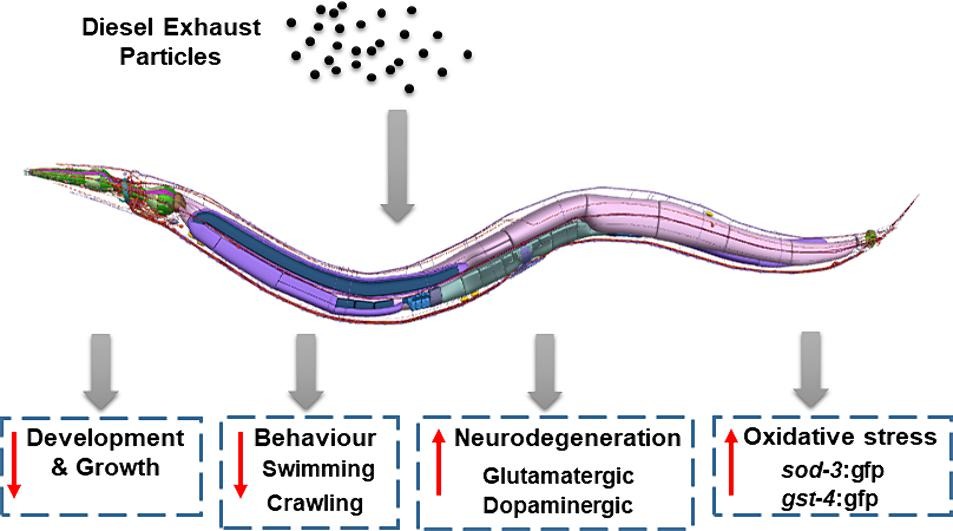
Thus, the article supports the detrimental impact of early-life and prolonged exposure to DEP, revealing a spectrum of adverse effects including developmental delays, retarded growth, oxidative stress, and behavioural changes, with significant alterations observed in locomotion behaviour and crucial glutamatergic neurodegeneration.
Furthermore, in silico docking simulations suggest the presence of an antagonistic competitive inhibition induced by DEP in the evaluated neuro-targets, stronger for the glutamatergic transporter than for the dopaminergic receptor from the comparative binding affinity point of view. The results underscore DEP’s distinctive neurodegenerative effects and suggest a link between locomotion defects and glutamatergic neurodegeneration in C. elegans, providing insights into environmental health risks assessment.
The Nanosafety Research Group at INL
INL is the coordinator of the LEARN project. Its Nanosafety Research Group is a multidisciplinary group focused on identifying the potential health risks of nanomaterials, with the following research lines:
- Organ-on-a-chip technology to evaluate the safety of nanomaterials used on products that could contact the skin or the respiratory tract.
- Epigenetics and in vitro/in vivo bridging models to evaluate the safety of different nanomaterials and pollutants.
- Toxicology and immunotoxicology of nanomaterials using sensors and high-throughput technologies.
- In silico evaluations using QSAR, QSPR, QSTR, machine learning and life cycle assessment.
Source: Chatterjee, N., González-Durruthy, M., Daniela Costa, M., Ribeiro, A. R., Vilas-Boas, V., Vilasboas-Campos, D., Maciel, P., & Alfaro-Moreno, E. (2024, March 22nd). Differential impact of diesel exhaust particles on glutamatergic and dopaminergic neurons in Caenorhabditis elegans: A neurodegenerative perspective. Environment International. Published by Elsevier Ltd. https://doi.org/10.1016/j.envint.2024.108597
Header image by Pim de Boer from Unsplash.
The LEARN project is a Horizon Europe project meant to monitor and evaluate indoor air quality at schools around Europe and its impact on children’s health. Our main goal is to develop and deploy novel sensors that can detect possibly harmful air pollutants, as well as advanced biosensors and optimised air remediation strategies. Find out more about our EU-funded project!