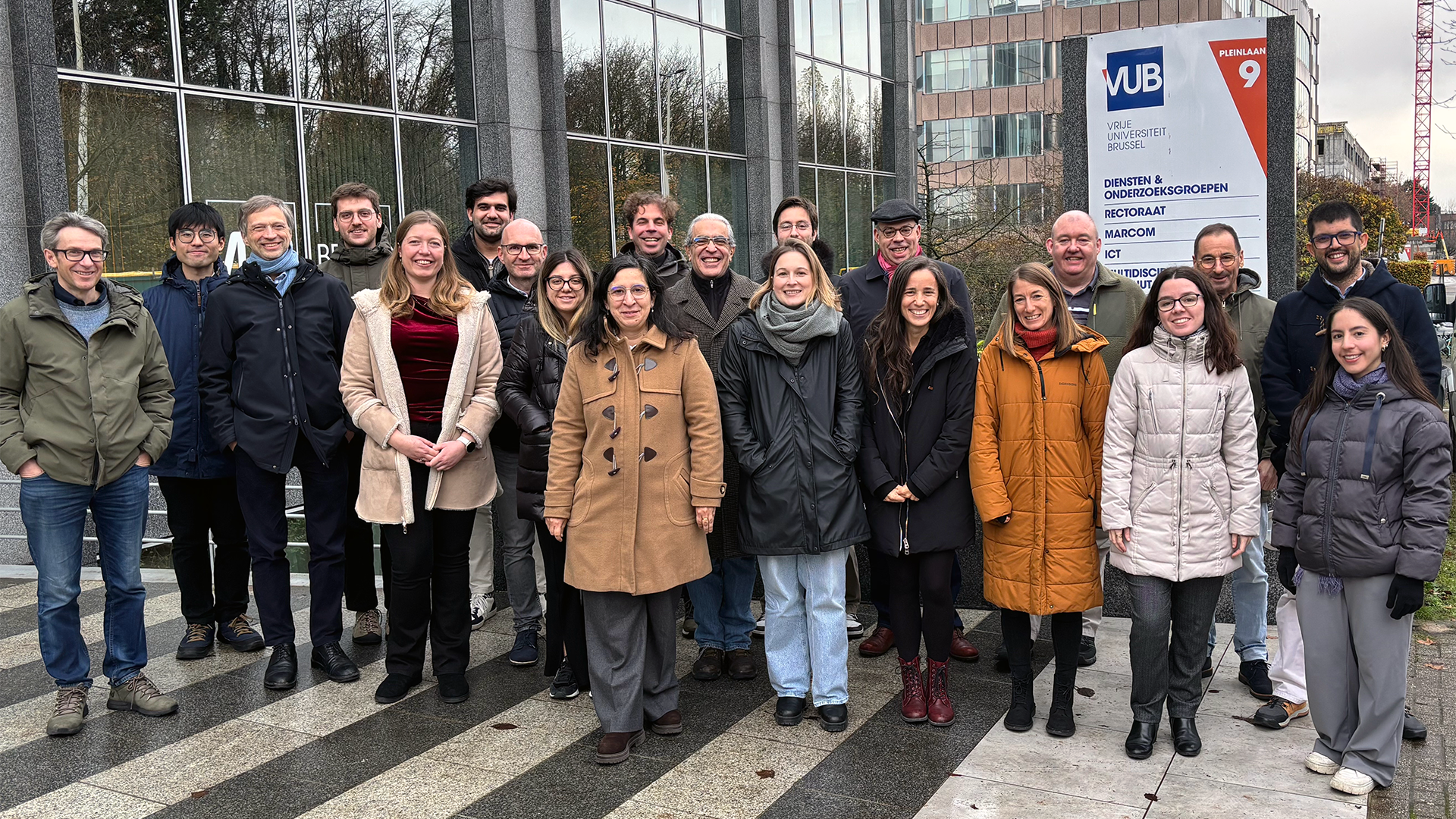
The LEARN project’s consortium gathered on 20-21 November in Brussels, Belgium, to celebrate the sixth General Assembly of the project and discuss the final steps in the last semester of project implementation. The meetings were led by the project’s coordinator INL and hosted by Vrije Universiteit Brussel in Belgium, specifically by the imec-SMIT-VUB research group.
Over the course of two days, the consortium planned all remaining technical activities, including the last cohorts at schools in Denmark and Greece, the air quality monitoring data gathered, the VOCs and UFP sensors developed, the advanced in vitro models and biosensors, and the air purification solutions. Discussions were also held about the dissemination of our final results, the upcoming policy recommendations, and the release of the LEARN Data Hub, among other actions.
All twelve partners of this Horizon Europe project were present, whether onsite or online: INL (Portugal), Aarhus University (Denmark), Alveolix (Switzerland), Envirometrics (Greece), FI Group (Spain), IMEC The Nederlands (The Netherlands), KU Leuven (Belgium), MANN+HUMMEL (Germany), NIA (Belgium), Hasselt University (Belgium), TU/e (The Netherlands) and VUB (Belgium).
What is the LEARN project’s current progress and achievements?
The LEARN project has made significant progress in recent months. The Belgian cohort at schools has concluded, involving 210 participants and reaching some preliminary results. In Denmark, recruitment continues with 119 participants, and data analysis will follow. The Greek cohort has recently begun its implementation phase at the first school and is expected to be concluded in March.
Alongside these efforts, a systematic review of biomonitoring indoor air exposure in children has been submitted for publication, and chemical analyses of air samples from the Belgian cohort are complete, with some preliminary results presented at international conferences.
On the technology front, the development of advanced sensors is well underway. The ultrafine particles (UFPs) sensor is still being refined, currently focusing on the setup for concentration and delivery to the sensing area, and the optimisation of the optical detection strategy in fluid/air. Whereas the volatile organic compounds (VOCs) sensor has reached the final integration stage, with field testing scheduled in Portuguese schools early next year, while patent application has received a positive initial review.
Toxicological studies using advanced two-dimensional lung and skin models have revealed that repeated exposure to low levels of indoor dust increases metabolic activity in lung cells, while further research is underway with organ-on-chip systems and biosensor models. Upcoming efforts will concentrate on optimising long-term exposure setups, analysing cytokine and chemokine release, and finalising protocols for repeated exposure under simulated breathing conditions. Toxicological evaluations will continue, new biomarkers will be incorporated into sensor platforms, and biosensor data analysis will be completed.
In the field of mitigation strategies, a second round of filter prototypes was finalised, and air purification devices were optimised for the school environment, and the particles trapped in them will be analysed later on, while exploring alternative sensor solutions to address any technical challenges encountered so far.
A prototype for the LEARN Data Hub is ready to start gathering data from the project and will be available soon. The consortium also held the first discussions about the upcoming policy recommendations based on our indoor air quality research, as well as the publication of the final results and the organisation of the LEARN project final event.
The LEARN project is a Horizon Europe project meant to monitor and evaluate indoor air quality at schools around Europe and its impact on children’s health. Our main goal is to develop and deploy novel sensors that can detect possibly harmful air pollutants, as well as advanced biosensors and optimised air remediation strategies. Find out more about our EU-funded project!